How to Become a Farrier
A farrier trims and shoes horses' hooves for a living. It's a skilled trade that combines hands-on metalwork, a working knowledge of equine anatomy, and the ability to handle horses safely.
The Short Version: 4 Steps to Become a Farrier
- Get hands-on training at a farrier school
- Build repetition trimming, forging, and shoeing
- Apprentice under an experienced farrier
- Keep learning and build the business side of the trade

Hands-on farrier training at Arkansas Horseshoeing School
Most farriers are self-employed, which means the work also requires business discipline.
There's no single required license in the United States, but solid training and real-world experience are what separate farriers who last from those who don't.
What Does a Farrier Do?
Day-to-day farrier work goes beyond trimming and shoeing. You will:
- Assess hoof health
- Identify problems early
- Communicate with horse owners and veterinarians
- Make decisions about how to handle each horse based on its conformation, its job, and its history
A backyard trail horse and a competitive reining horse may need very different approaches.
The work is physical, it requires patience with animals, and it rewards people who are willing to keep learning. If you want a career where your hands produce something real every day, farriery is worth a serious look.
Do You Need a Degree or License to Become a Farrier?
No. In the United States, you do not need a college degree to become a farrier, and farriery is generally not licensed by a state or federal government agency.
What matters most is training, hands-on repetition, and the ability to work safely and competently under horses.
Certification is voluntary, but it is respected within the trade and can help show horse owners, trainers, and veterinarians that you take the work seriously.
The American Farrier's Association offers a voluntary certification path that begins with Farrier Classification (FC) and continues through Certified Farrier (CF), Certified Tradesman Farrier (CTF), and Certified Journeyman Farrier (CJF).
CF is the first full certification level and is open to farriers who have at least one year of horseshoeing experience. CJF is the highest level of AFA certification and is open to candidates who have completed the CF level and have at least two years of horseshoeing experience.
Arkansas Horseshoeing School teaches toward AFA standards, and after successful completion of an AHS farrier training course, students receive a certificate of completion from the school, not an AFA certification. D. Paul Dorris, CJF, leads the program and instruction is built around the practical skills farriers need in the field.
The Usual Path to Becoming a Farrier
There is no single route into farriery, but the path most working farriers follow looks something like this:
1 Learn the basics through formal training
A farrier school gives you the foundation: horse handling, hoof anatomy, trimming, basic forging, and introductory shoeing.
Programs typically run from 8 to 24 weeks depending on depth and pace. The goal is not to make you an expert in a few months. It is to give you a solid base of correct habits and core knowledge so you can keep building safely.
2 Get hands-on repetition while you train
Good training programs are built around daily practice, not lectures.
You should be trimming hooves, working at the forge, and shoeing horses under direct supervision throughout your program. The more repetition you get under qualified instruction, the faster your hands and your eye develop.
3 Apprentice under an experienced farrier
This is where the real learning accelerates. Working alongside a farrier with an established client base shows you how the trade actually runs: how to manage a schedule, handle difficult horses, communicate with owners, solve problems on the fly, and build a reputation one barn at a time.
Apprenticeship is also how most new farriers get their first clients. When the farrier you work with recommends you, those referrals carry real weight. That kind of credibility takes time to build on your own.
4 Continue learning as your skills grow
Farriery is not a trade where you learn everything in school and then coast.
The best farriers keep learning through clinics, continuing education, professional organizations, and by working on a wider range of horses over time. Your skills in year five will look very different from your skills in year one.
Is Farrier Work Physically Hard?
Yes. This is a physically demanding trade. You will spend long hours bent under horses, working with hand tools, and handling animals that outweigh you several times over.
Lower back strain, sore hands, and occasional bumps and bruises are part of the job. The work is repetitive, and if you do not take care of your body, it will catch up with you over time.
The good news is that much of the wear and tear is preventable:
- Proper horse handling reduces confrontations.
- Good body mechanics and ergonomic habits protect your back and joints.
- Learning to work efficiently, rather than just harder, is something experienced farriers understand well.
You do not need to be exceptionally strong to succeed as a farrier. But you do need to be physically capable, willing to work through tough days, and committed to taking care of yourself so you can sustain a long career.
Can a Woman Be a Farrier?
Yes. Farriery is physically demanding, but success in the trade is not about brute strength alone. Good horsemanship, balance, patience, body mechanics, and technique matter as much as raw power.
Women attend Arkansas Horseshoeing School every year, and separate bunkhouse housing is provided. Strong training teaches students how to work efficiently, handle horses calmly, and preserve their physical health over the long term.
That matters whether the student is male or female.
The Business Side of Being a Farrier
Most farriers are self-employed, and that changes what the job requires. Technical skill gets you started, but business discipline is what keeps you going.
On any given day, you are not just shoeing horses. You are also:
- Scheduling appointments
- Planning an efficient driving route
- Communicating with clients
- Managing your supplies
- Keeping records
- Making sure you get paid on time
If you let any of those things slip, it affects your income and your reputation.
Client communication matters more than many new farriers expect. Being on time, returning calls, and explaining what you are doing under the horse builds trust.
The farriers who stay busy long-term are usually the ones who are dependable and easy to work with, not just technically skilled.
None of this should be discouraging. But if you are considering this trade, go in with your eyes open about the business side. The most successful farriers treat their work like a business from day one.
How Much Can a Farrier Earn?
This is one of the most common questions people ask when considering farriery as a career, and it deserves a direct answer.
The trade can provide a strong living, but income varies widely based on your location, skill level, client base, reputation, and how well you run the business side of the work.
According to the American Farriers Journal Business Practices Survey, full-time farriers in the United States average about $119,770 a year in gross income.
The same reporting shows younger farriers under 25 averaging about $60,000, while farriers ages 30 to 39, who have usually built more skill, efficiency, and clients, average about $139,411.
AFJ also reports national averages of about $57.80 for a trim and about $181.02 for a trim and setting four keg shoes. These are industry gross benchmarks, not guaranteed take-home pay.
Overhead matters too. Supplies, fuel, propane, truck costs, insurance, wear on your vehicle, and tool replacement all come off the top.
Early in your career, expect to earn less while you build your skills and your client base. Apprenticeship often helps bridge that gap by giving you more experience, more repetition, and a better path to referrals.
Over time, as your reputation grows and your efficiency improves, your earning potential usually grows with it.
Why Apprenticeship Matters
If there is one thing that separates farriers who build lasting careers from those who struggle early on, it is apprenticeship.
School teaches you the core skills. Apprenticeship teaches you how to apply them in the real world.
When you work alongside an established farrier, you see how they handle a full day's route, manage difficult horses, communicate with clients, and solve problems that no classroom can fully prepare you for.
Just as importantly, apprenticeship builds your reputation before you go out on your own. The clients at those barns get to know you. When the farrier you work with sends a referral your way, it comes with trust already attached.
That kind of head start is hard to replicate any other way.
Building a client base from scratch is slow work. Apprenticeship compresses that timeline significantly. That is why the best farrier schools put real emphasis on helping graduates find apprenticeship positions after training.
How Arkansas Horseshoeing School Fits Into That Path
Arkansas Horseshoeing School was built around the path most successful farriers follow: strong hands-on training first, then apprenticeship, then continued growth in the field. The school is led by D. Paul Dorris, CJF and keeps classes small with 1 instructor for every 5 students, so students get direct correction and more hands-on guidance while they train.
Training is built around the real work of the trade. Students learn horse handling, equine anatomy and physiology, hoof trimming and balance, blacksmithing at the forge and anvil, diagnosing hoof problems and diseases, horseshoeing, and the business side of farriery.
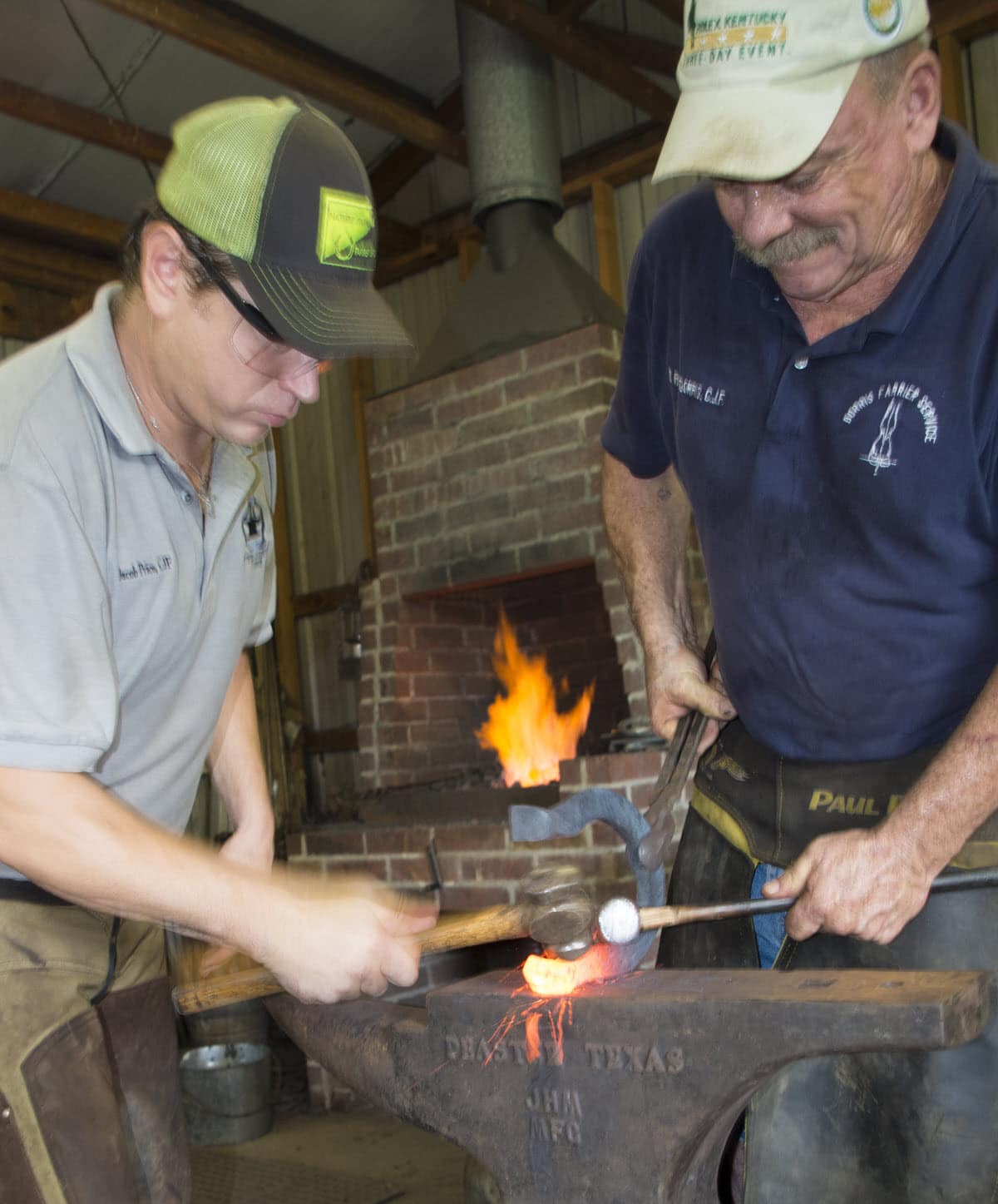
Jacob Price, CJF and D. Paul Dorris, CJF demonstrating forge and anvil technique
The program is hands-on most days, with time spent trimming, forging, shoeing horses, and going into the field with an instructor to barns and horse owner facilities.
Farrier classes run 5 days a week, Tuesday through Saturday, starting at 8:30 am. Most days finish around 3:30 pm, but some days may go until 8 to 9 pm. In simple terms, students are done when the horses are done. Paul wants you to get as much time under horses as possible so you are better trained when you graduate.
This is a trade school environment meant to prepare students for real work, not just classroom study. Unlimited propane and steel are available for practice, and forges are available 24/7 so students can keep building repetition outside regular class instruction.
Graduates of the traditional courses receive a farrier tool set valued at about $2,500, including a forge, anvil, and hand tools.
A few practical things to know:
- On-site bunkhouse boarding for $50 per month
- Small class sizes
- Classes start the first Tuesday of each month
- GI Bill® and VA benefits are accepted
- For students using VA benefits, the standard $500 deposit is not required
- Assistance in finding an apprenticeship
- Students ages 16 to 17 may enroll, but they must bring an insurance card and a signed parental consent form
The consent form is available on the application page.
The school offers traditional course options from 8 to 24 weeks. Tuition currently ranges from $11,900 to $20,900, depending on course length.
Veterans and eligible students can review veteran and VA benefits for farrier training before choosing a course or applying.
After graduation the school emphasizes apprenticeship to help students move from training into real-world work. You can compare AHS course options to find the length that fits your schedule and goals, whether that is the 8-week farrier course for a focused foundation or the 24-week farrier course for more complete preparation.
Students comparing training paths can also see how those options fit into our farrier school as a whole.
See the School in Action
This 4-minute video shows the facility, introduces D. Paul Dorris, CJF, and includes a student currently in training.
Next Step
If you are serious about this trade, the next step is to look at the training options and decide what fits.
- Compare AHS course options and see all traditional course lengths from 8 to 24 weeks
- Meet D. Paul Dorris, CJF and learn about his background
Questions? Call 479-858-1011 (8 AM to 8 PM).
Ready to Get Started?
Class sizes are limited. Apply today or call us to find the right course for your goals.